Know more about who is paying
A charge now names the network behind the customer's IP address, and warns when that address is in another country than the one they gave.
2 min read Fraud signals
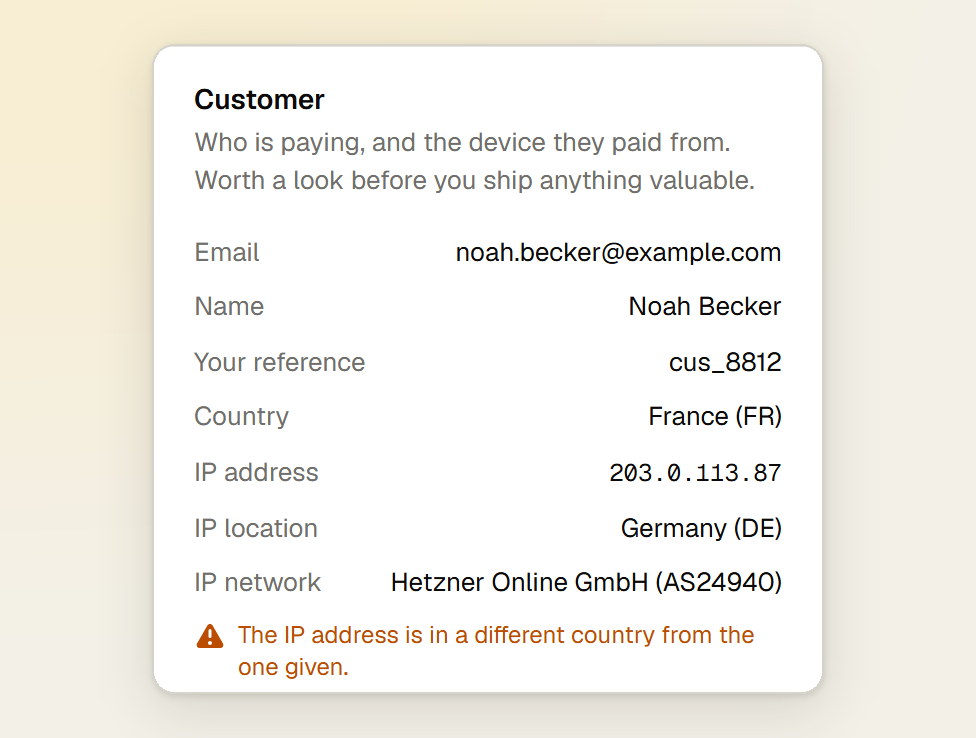
A crypto payment cannot be charged back, but the goods you ship for it can still go to someone who should not have them. Each charge's page now says more about who paid, so you can take a second look before you send anything valuable.
The network behind the IP address
Every charge with an IP address now names the network that address belongs to, such as "Hetzner Online GmbH (AS24940)". A customer on a home or mobile connection shows their internet provider. One on a hosting company's network is often a bot, or someone hiding behind a server.
The network is looked up in IPinfo's free database, which we keep on our own servers, so your customers' addresses are never sent anywhere to be looked up.
A warning when the country does not match
When a customer starts a payment at your checkout, the charge also keeps the country their IP address is in. If that differs from the country the customer gave, the charge's page warns you beside it, and a payment made through Tor, which hides where the customer is, is marked as such.
A charge you create through the API comes from your own server rather than the customer's browser, so we never record your server's address as theirs. Pass the customer's ip_address
and user_agent
in the charge's customer
object, and the charge names their network too.
Their other payments, and a better search
Beside the customer's details, a charge lists your other charges with the same email address or IP address, so a repeat buyer and a repeat problem are both easy to spot.
The search box and the charges list now find a charge by its deposit address, the hash of a transfer to it, its payout's hash or the customer's IP address, as well as by its code, the customer's email or name and its description.
In the API and in webhooks
The charge's customer
object carries the same facts as ip_country
, ip_asn
and ip_network
, read-only, so your own systems can act on them. The charges reference describes each field.