USDT on Tron, and three more networks
Customers can now pay USDT on Tron, USDT and USDC on Polygon and Arbitrum One, USDC on Base, POL, and ETH on Arbitrum One.
2 min read Coins
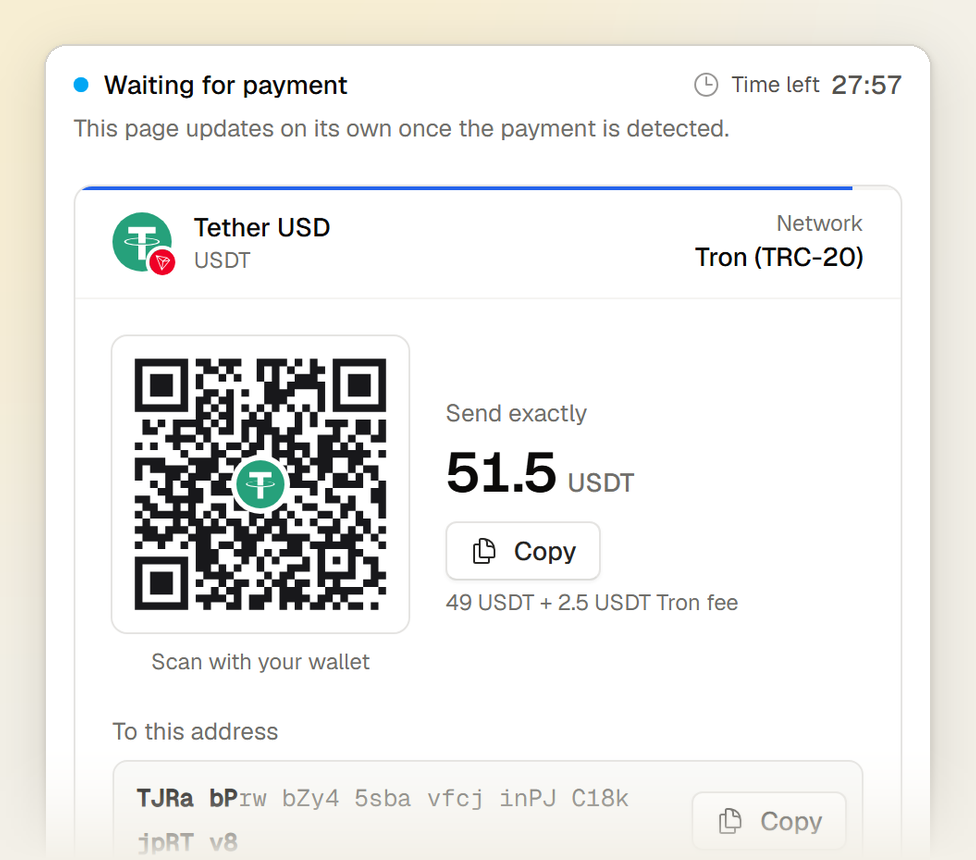
Customers pay with the stablecoins they already hold, on whichever network their wallet or exchange uses. Your checkout now takes USDT on Tron, and three more networks:
- Polygon: USDT, USDC and POL, Polygon's own coin.
- Arbitrum One: USDT, USDC and ETH.
- Base: USDC.
On Polygon and Arbitrum One, Tether's USDT is USDT0, its version for those networks, so the checkout names the network "Polygon (USDT0)" or "Arbitrum One (USDT0)", which is what a customer's wallet shows.
USDT on Tron carries a 2.5 USDT Tron fee
Passing a USDT payment on over Tron costs about the same whatever its size, because each transfer needs Tron's energy. So the customer pays it: a USDT payment on Tron asks for 2.5 USDT on top of the price. The checkout says so before the coin is chosen, and again on the payment page and the receipt.
That fee covers sending the money on to you, so your share pays nothing for it. Our processing fee is worked out on the price alone, never on the Tron fee. Through the API and in webhooks, a charge shows it as network_surcharge
.
Each network has its own payout address
To offer a network, add a payout address for it under Payment settings. Polygon, Arbitrum One and Base each take an address of their own, separate from your Ethereum one, so nobody is paid on a network you did not choose: an exchange deposit address or a smart-contract wallet may only exist on one of them. A Tron address takes USDT as well as TRX.
As soon as an address is saved, the coins of that network appear on your checkout, and you can turn any of them off again under Settings → Organizations → Checkout.
Trying them in test mode
USDT on Tron works in test mode on Tron's Nile network, whose faucet hands out test USDT. Polygon, Arbitrum One and Base run in live mode only, so try them with a small real payment.
The supported coins page lists every coin and network on offer, and GET /v1/assets
gives the lowest price each can be charged at.